Flat-pack or millwork shop? We install both across Oakville. Here's the real 2026 cost gap, where each option fits the local housing stock, and the semi-custom middle ground most homeowners land on.
IKEA vs Custom Kitchen Costs in Oakville: The Real Gap
The honest numbers first. As of 2026, flat-pack cabinets from big-box suppliers like IKEA sit at the bottom of the stock band — roughly $150–$400 per linear foot installed — while true custom cabinetry from a GTA millwork shop runs $800–$1,500+ per linear foot. On a typical 20–25 foot Oakville kitchen, that is the difference between a $3,000–$6,000 cabinet package and $18,000–$40,000 or more.
Cabinets are usually the largest single line in a kitchen budget — 30–40% of the total — so this one choice swings the whole project more than countertops, appliances, and flooring combined. A full kitchen renovation in the GTA starts around $25,000 and typically lands between $25,000 and $80,000; see what a full kitchen renovation costs in Toronto for the complete 2026 breakdown. The cabinet route you pick largely decides which end of that range your project occupies, which is why we price it out both ways for clients who ask.
Box Construction and Durability: What You Get at Each Price
Flat-pack boxes are melamine-coated particleboard, assembled on site with cam fittings. That is not automatically bad — the hinges and soft-close drawer hardware on the better flat-pack lines are genuinely decent, and a carefully installed melamine box will survive a decade of family cooking. The weak points show up at the edges: particleboard swells if a dishwasher leak or a slow supply-line drip sits against it, and assembly quality varies with whoever builds the boxes.
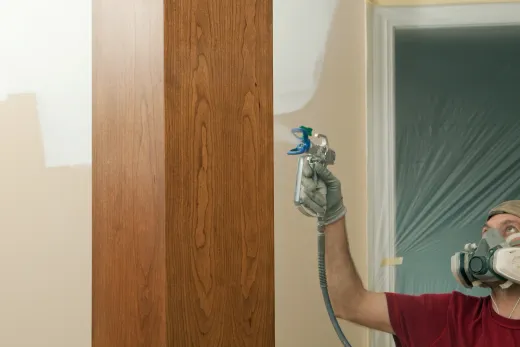
Custom shops build plywood boxes with doors in MDF or solid wood. At the materials level, one GTA supplier prices custom MDF doors around $275 per linear foot against roughly $450 for solid wood — and MDF paints beautifully and resists warping, which is why most painted shaker kitchens we install use it. Plywood carcasses handle moisture better, hold screws better, and can be repaired rather than replaced after water damage. What you are really buying at the custom tier is material, joinery, and a finish sprayed in a local shop instead of a factory overseas — plus a builder who answers the phone if a door sags in year three.
Fitting Cabinets to Older Oakville Homes: Sizes and Fillers
Stock cabinets come in fixed increments. In a straight-walled newer subdivision, that works fine. In Old Oakville's century homes — where walls are rarely square and floors have had a hundred years to settle — a modular run needs filler strips at every wall and awkward gaps above the uppers. The 1960s–70s pockets like College Park and Falgarwood bring their own homework: one local inspection firm estimates around 60% of Oakville homes from the 1965–78 era carry some aluminum wiring (treat that as an estimate, not a census), so an ESA-permitted electrical check belongs in the plan before new appliance circuits go in.
Custom cabinetry is scribed to your actual walls: a full-height pantry run that meets an off-level ceiling cleanly, angled fillers that disappear, a box sized to the odd 14-inch gap beside a chimney breast. Glen Abbey's mid-1980s two-storeys are usually friendlier to modular sizing — straighter framing, standard ceiling heights — so flat-pack fits there with far less compromise than it does south of Lakeshore.
Lead Times, Installation and Who Does the Work
Flat-pack wins on speed of supply. Most components are available within weeks, and a missing or damaged part is a store run rather than a factory reorder. Custom shops in the GTA typically hold multi-week production queues, so we order custom cabinetry well before demolition starts — the boxes should arrive when the room is ready for them, not the other way around.
Installation is where flat-pack projects go sideways. The boxes must be assembled square, hung level on walls that are not, and finished with fillers, panels, and crown that the instruction sheets barely mention. We install both types, and a flat-pack kitchen fitted by an experienced carpenter looks dramatically better than the same boxes assembled over a long weekend — the gaps, reveals, and end panels are the tell. Either way, the renovation around the cabinets — electrical, plumbing, flooring, backsplash, paint — runs the same 4–6 week schedule for a typical kitchen renovation in Oakville, so the cabinet choice changes the budget more than the calendar.
Resale Considerations in Oakville's Market
Oakville buyers at the detached price point expect finish quality to match the house. In our experience, a well-executed flat-pack kitchen reads fine in a starter townhouse or an income property, but in Old Oakville or on the established streets near Bronte's harbour, buyers and their agents spot particleboard gables and visible filler strips quickly. That does not mean flat-pack kills a sale — a clean, current kitchen always beats a dated one — but it rarely earns a premium in a neighbourhood where comparable listings show custom or semi-custom millwork.
The practical rule we give clients: match the cabinet tier to the home's value band and your holding period. Selling within five years in a high-value pocket usually argues for at least semi-custom, because the kitchen will be photographed, walked, and compared. Staying ten years or more? Buy the kitchen you want to cook in and let resale sort itself out.
The Semi-Custom Middle Ground
Semi-custom splits the difference: factory-built lines that allow depth changes, non-standard widths on some boxes, and upgraded door styles and finishes. In the GTA they run $300–$900 per linear foot installed — entry lines at $300–$500, upper tiers at $500–$900 — which puts a 20-foot kitchen at roughly $8,000–$18,000 in cabinets. That is half of full custom with most of the fit-and-finish benefit, and it is where the majority of our owner-occupied Oakville projects land.
Two other paths are worth knowing. If your existing boxes are sound, refacing instead of replacing typically saves 40–50% of the cabinet cost. And when a client wants true custom only where it counts, we mix custom kitchen cabinets on the pantry wall and island with semi-custom perimeter runs. Done in matching finishes, nobody can spot the seam — and the budget notices the difference.
Which Route Fits Your Budget and Timeline
A short decision guide from twenty years of installing all three tiers:
- Flat-pack makes sense when the budget is tight, the walls are straight, the home is a rental or starter property, and you have a skilled installer lined up.
- Semi-custom is the best cost-to-quality ratio for most owner-occupied Oakville kitchens, typically inside a $35,000–$60,000 total project.
- Custom earns its price in century homes, unusual layouts, high-value neighbourhoods, and any kitchen you plan to live with for 10+ years.
Whichever way you lean, get comparable numbers in writing before committing — same layout, same counters, same appliances, cabinets priced side by side. We have renovated kitchens across Oakville since 2004, we are licensed and insured, and every project carries our 2-year workmanship warranty. Tell us about your kitchen and we will quote both routes so you can see the real gap for your actual room.
Ready to start your renovation?
Our team is here to help you bring your vision to life. Get a free, no-obligation quote today.
Get Free QuoteFrequently Asked Questions
Clear answers to the questions Ontario homeowners ask most.