Kitchen Renovation Budget Breakdown: Where the Money Goes
Cabinets take 30-40% of a GTA kitchen budget and labour absorbs 30-50%. Here is how $30K, $50K and $80K actually get spent in 2026 — and how to keep yours from drifting.
The Standard Kitchen Budget Split: Cabinets, Labour, Stone
Two lines dominate every kitchen budget we build. Cabinets absorb 30–40% of the total, and labour — demolition, installation, trades, project management — takes 30–50%. Everything else fits around those two.
For a typical full renovation in the GTA as of 2026, the component ranges look like this:
- Cabinets: $3,000–$40,000+ depending on tier — the single largest line.
- Countertops: $1,500–$15,000; a typical quartz kitchen lands $3,200–$6,500 installed.
- Appliances: $2,000–$25,000+, with most families in the $4,000–$10,000 mid-range band.
- Backsplash: $500–$7,000. Plumbing: $1,000–$8,000. Electrical: $1,000–$7,000.
- Flooring: $1,000–$10,000. Design and permits: $500–$6,000.
Across the GTA, full kitchen renovations typically run $25,000–$80,000, and Toronto proper prices about 15–20% above the Ontario average. Our kitchen renovation cost guide for Toronto breaks the ranges down by tier; this post is about how the money distributes inside them.
Sample Budgets: What $30K, $50K and $80K Buy in the GTA
At $30,000 you are buying a solid same-layout renovation: stock or entry semi-custom cabinets around $8,000–$10,000, quartz counters near $3,500, a mid appliance package, ceramic backsplash, new flooring in the kitchen only, and roughly a third of the budget going to demolition and installation labour. Four to six weeks of work. No walls move.
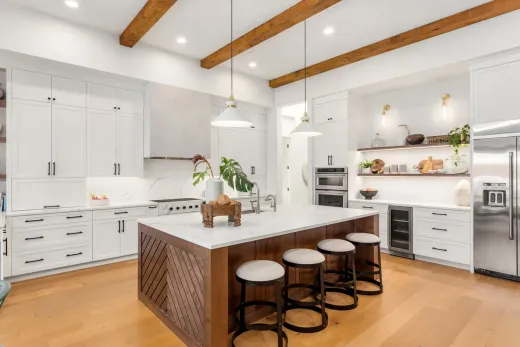
At $50,000 the jump goes mostly into cabinetry and layout. Semi-custom boxes with proper drawer banks, an island if the room allows, under-cabinet lighting, upgraded counters with a better edge profile, and enough electrical budget for pot lights and new circuits. This is the middle of the GTA's mid-range band and where most of our Vaughan and Markham projects land.
At $80,000 you are at the top of the typical range: custom or high-end semi-custom cabinetry, premium stone, panel-ready or pro-style appliances, and often a structural change — removing a wall runs $5,000–$15,000 once you include the engineered beam, and pushes the schedule toward 8–12 weeks. In post-war back-splits around Scarborough and Etobicoke, that wall is usually load-bearing, so the engineering is not optional.
Where to Splurge and Where to Save
Splurge on the things you touch fifty times a day and the things buried in walls. Good cabinet hardware and drawer construction, quality installation labour, and proper electrical work pay back every single morning. Counters are worth a mid-tier spend — they take the daily abuse.
Save without regret on:
- Appliances: mainstream packages bundle-discount 10–30% at Canadian retailers. A $6,000 package cooks dinner just as well as a $20,000 one.
- Backsplash: ceramic subway tile at $500–$1,500 installed reads clean and timeless; save the $3,500+ slab treatment for a kitchen you will keep for decades.
- Door material: painted MDF shaker fronts cost well under solid wood and hold paint better through Ontario's humidity swings.
The worst place to save is labour. The GTA's cheapest quote usually means uninsured trades or a scope with pieces quietly missing. More ideas along these lines are in our answer on saving money without cutting quality.
Contingency: Why 10-20% Is Non-Negotiable
Every kitchen budget we write carries a contingency of 10–20%, and in older housing stock we push to the top of that. The reason is what walls hide. Pre-1950 Toronto homes can still carry knob-and-tube wiring behind a modern-looking panel. Houses built 1965–1976 — a huge share of Scarborough, North York, and early Erin Mills — often have aluminum branch wiring that insurers want addressed once it is exposed. And anything built before about 1990 may contain asbestos in drywall compound or flooring; testing is the only way to know.
Hazmat and hidden-condition discoveries are the single most common budget-buster in pre-1990 GTA renovations. A kitchen is the worst room to find them in, because the walls behind cabinets have not been opened in decades.
If the contingency goes unspent, it comes back to you — but pretending surprises will not happen is how a $50,000 project becomes a $58,000 argument. Our guide to setting a renovation budget with contingency covers how we size it per house.
HST, Design Fees and Other Soft Costs
The quiet lines catch people off guard more than the loud ones. Ontario's 13% HST applies to renovation contracts, and most contractor quotes exclude it — on a $50,000 kitchen that is $6,500 you need to have ready. When comparing quotes, confirm every one treats HST the same way.
Design and permit costs typically run $500–$6,000 for a kitchen. A cabinet-and-counter swap in place needs no building permit, but moving the sink plumbing, opening a wall, or relocating ductwork does — Toronto's minimum permit fee is $214.79 as of 2026, and a full residential permit package generally lands $700–$3,500. New circuits go through the ESA rather than the city; those notification fees usually run $90–$300 and are built into the electrician's quote.
Add delivery and disposal bins, possible eat-out costs while the kitchen is down for four to six weeks, and appliance storage if timing slips. None of these break a budget alone; unplanned, together, they sting. We keep a fuller list in hidden soft costs of renovating in Toronto.
Keeping the Budget on Track With Your Contractor
Budgets rarely blow up in one dramatic moment. They drift — a tile upgrade here, a moved outlet there, each one reasonable, none of them written down. The fix is process, not willpower.
Finalize every selection before demolition starts. Cabinets, counters, tile, fixtures, appliance models — decided, priced, and in the contract. Mid-project decisions cost more and stall trades. Then insist that every change goes through a written change order with a price attached before the work happens; our answer on how change orders work explains what a proper one looks like.
Finally, match the payment schedule to completed milestones, never to the calendar. A contractor confident in their scope will not resist that structure.
When budgets are built this way — honest ranges, real contingency, selections locked early — the number you sign is the number you pay far more often than not. That is how we have run kitchen renovations across Toronto and the GTA since 2004, with a 2-year workmanship warranty behind the work.
Ready to start your renovation?
Our team is here to help you bring your vision to life. Get a free, no-obligation quote today.
Get Free QuoteFrequently Asked Questions
Clear answers to the questions Ontario homeowners ask most.