A slow leak under the sink can destroy cabinet boxes before you smell it. How we judge what is salvageable, what replacement costs in 2026, and when damage justifies a bigger rethink.
How to Tell If Water-Damaged Cabinets Are Salvageable
The material matters more than the amount of water. Plywood boxes and solid wood face frames can survive a soaking if they dry out quickly — sand, refinish, done. Particleboard and MDF cannot. Once those materials swell, they never shrink back, and their screw-holding strength is gone for good.
Our field test is simple. Empty the sink cabinet and press hard on its floor and lower side panels. Solid, flat, and paint intact means you likely caught it early. Sponginess, a ripple in the surface, flaking melamine, or a bottom panel that has bowed away from its edges means the substrate has failed. Check the toe kick area too — dishwasher leaks run under the boxes where you cannot see them, and the first visible sign is often a baseboard or a strip of flooring lifting two cabinets away from the leak.
If only doors and drawer fronts took the hit and the boxes stayed dry, you are in luck: fronts are replaceable components, and that is a far smaller job than new cabinetry.
Swollen MDF, Delamination and Mould: When Repair Fails
Three findings take repair off the table for us. First, swollen panels — a blown-out particleboard floor or side wall has lost its structure, and no amount of clamping or filler restores it. Second, delamination: when the melamine or veneer skin separates from the core, moisture has travelled through the panel, not just across its surface. Third, mould. Kitchens are warm, and a cabinet interior that stayed damp through one of our humid GTA summers is an ideal growing surface. Surface spotting on a plywood panel can sometimes be treated; mould inside particleboard cannot, because the material soaks contamination through its full thickness.
There is also the question of what the cabinet sits on. Water that pooled long enough to wreck a box has usually reached the subfloor. We routinely open up the base of a "one cabinet" repair and find blackened OSB that needs cutting out. Budget mentally for the floor, not just the box — it is the most common surprise in these jobs.
Matching Doors and Finishes Years Later
Replacing one or two damaged cabinets sounds economical until you try to match them. A ten-year-old kitchen presents three problems: the manufacturer may have discontinued the door style, the finish has aged — UV exposure shifts both wood tones and painted finishes — and sheen levels rarely match between old and new production runs.
Realistic options, in ascending cost:
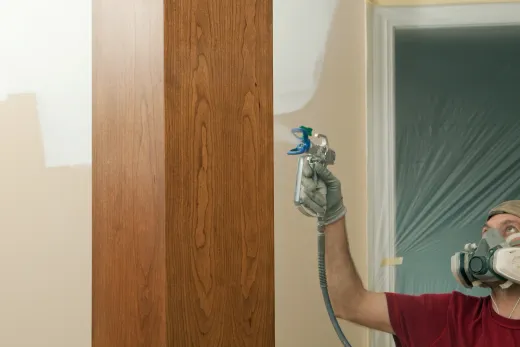
- Replace the damaged boxes and have a spray shop refinish every door and front in the kitchen so the colour reads as one
- Reface the entire kitchen — new doors and fronts on all surviving boxes plus new boxes where needed, typically 40-50% cheaper than full replacement
- Replace the run entirely, which is often the honest answer for lower-end cabinetry where a single box costs nearly as much as its share of a new set
A colour-matched repair that is almost right will bother you every day. When clients are on the fence, we bring a door to the cabinet shop for a match assessment before anyone commits.
Fix the Leak First: Plumbing and Dishwasher Culprits
New cabinets over an unfixed leak is a job we refuse to do. The usual suspects, roughly in order of frequency: the sink drain assembly and its slip joints, the dishwasher supply connection, braided or plastic supply lines to the faucet, the fridge water line, and failed caulking at the counter seam behind the sink.
One GTA-specific check: if your home or condo was built between 1995 and 2007 — which covers a lot of Richmond Hill, Markham, and Vaughan subdivisions and plenty of Toronto condos — look for Kitec plumbing, an orange or blue plastic pipe with brass fittings. It is failure-prone, the class-action settlement window has closed, and remediation is now out of pocket, so a Kitec kitchen leak is a strong argument for replacing the piping while the cabinets are already out.
Like-for-like fixture repairs need no permit, but if fixing the problem means relocating the sink or rerouting drains, a plumbing permit comes into play. Either way, the plumbing gets pressure-tested and signed off before a single new box goes in.
Repair and Replacement Costs in 2026
For component-level fixes — new doors, a refinished panel, hardware — you are typically into hundreds, not thousands, and a refacing approach scales from there. Full cabinet replacement is priced per linear foot in the GTA as of 2026:
- Stock cabinets: $150-$400 per linear foot installed
- Semi-custom: $300-$900 per linear foot
- Custom: $800-$1,500+ per linear foot
As complete packages, a typical kitchen runs $3,000-$6,000 in budget stock cabinetry, $8,000-$18,000 mid-range, and $18,000-$40,000+ for high-end custom work. Remember the add-ons that ride along with box replacement: counters usually cannot be reused once cabinets move, subfloor repairs are common, and backsplash tile rarely survives removal intact. That is why a "cabinet job" that started at a few thousand dollars can grow — and why we scope the whole picture up front. Our Toronto kitchen renovation cost guide breaks down every line item.
Insurance Claims and When Damage Justifies a Full Reno
Whether insurance helps depends on how the water got there. Sudden and accidental events — a burst supply line, a failed dishwasher pump — are commonly covered; slow leaks that dripped for months often are not, because policies treat them as maintenance. Policies differ, so photograph everything before touching it, keep the failed part, and call your insurer before demolition. A contractor's written assessment of the damage helps your adjuster scope the claim properly.
As for scope: if the damage is confined to one or two boxes in a kitchen you otherwise like, repair or partial replacement is the sensible play. But if the kitchen is twenty years old, the layout frustrates you, and insurance is already covering demolition and part of the rebuild, topping up the claim toward a full kitchen renovation is often the best money you will spend — you pay once for disruption instead of twice. Send us photos through our contact form and we will give you an honest read on which situation you are in.
Ready to start your renovation?
Our team is here to help you bring your vision to life. Get a free, no-obligation quote today.
Get Free QuoteFrequently Asked Questions
Clear answers to the questions Ontario homeowners ask most.