The smartest bathroom we build is the one a client never has to renovate again. Aging-in-place design has quietly become good design — and in 2026 the federal tax credit helps pay for it.
Designing a Bathroom You Won't Outgrow
Aging-in-place used to mean institutional white grab bars and a plastic shower seat. That era is over. The accessible bathrooms we build across the GTA now look like the spa bathrooms in our portfolio — the accessibility is engineered in, mostly invisible, and it makes the room better for everyone, including the grandkids.
The numbers first. A dedicated accessible bathroom renovation in the GTA typically runs $20,000–$40,000 as of 2026 — curbless shower, reinforced walls, slip-resistant tile, wider clearances, comfort-height fixtures. That sits modestly above the $15,000–$30,000 typical range for a standard full bathroom, because the delta is mostly planning and blocking rather than expensive product. And the federal Home Accessibility Tax Credit can return roughly $2,800–$3,000 of it (details below).
The core principle: every accessibility feature costs a fraction as much during a renovation as it does as a retrofit after a fall. If you are gutting a bathroom in your fifties or sixties — or renovating for parents — this is the renovation to think a decade ahead on.
Curbless Entry and Slip Ratings: The Foundation
The two features that prevent the most bathroom injuries are the least visible: a floor with no step and a surface with real grip.
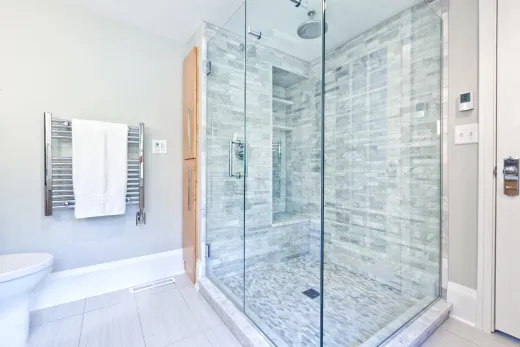
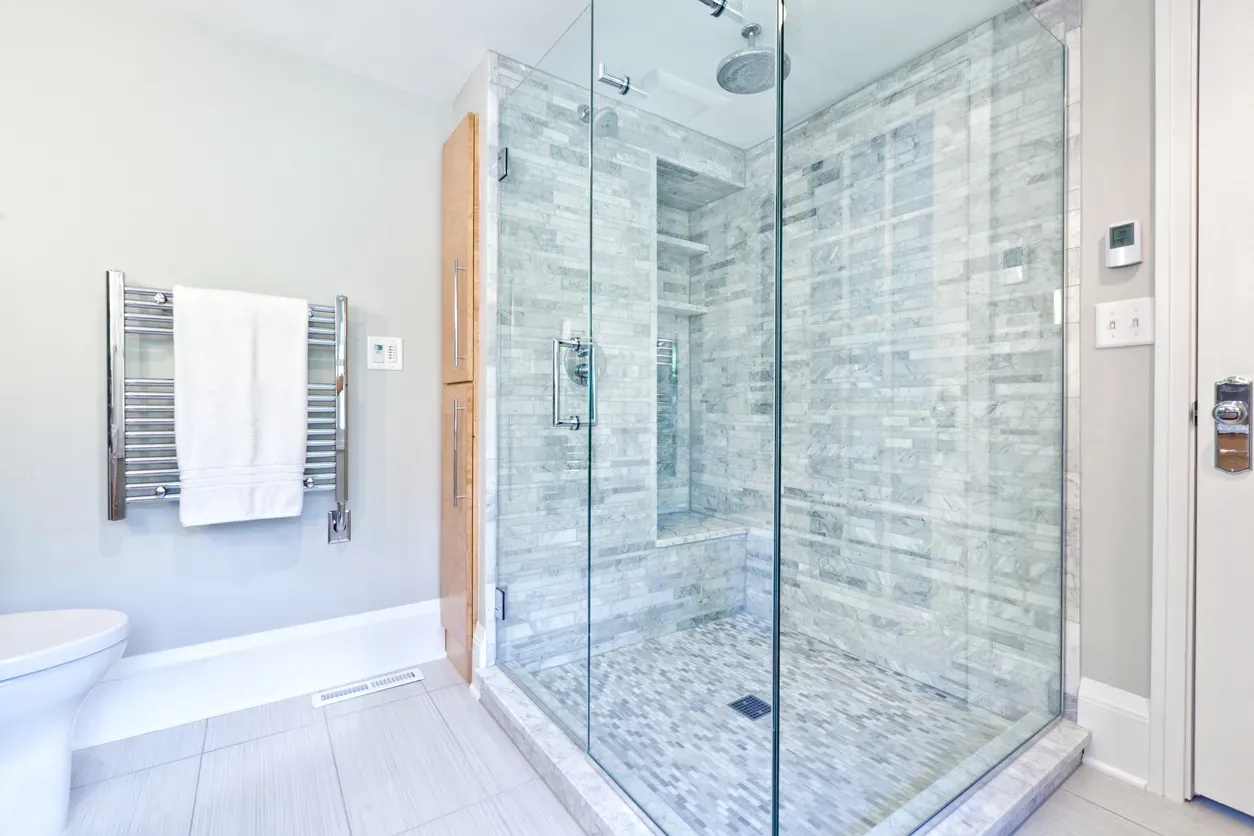
A curbless shower eliminates the six-inch tub wall or shower curb that becomes a genuine hazard as balance and hip mobility change. During a full renovation, we recess the shower area into the subfloor so finished tile runs level from door to drain — no threshold, nothing to catch a foot or a walker wheel, and it happens to be the cleanest look in bathroom design right now. Our comparison of curbless walk-in showers vs tubs covers when to keep a tub in the house.
For the floor itself, ask your contractor about slip resistance ratings — matte and textured porcelain grips far better than polished tile when wet, and smaller-format tile in the shower zone adds grout lines that work like tread. Skip polished marble floors entirely in this room. None of this costs extra; it is purely a selection decision, made once, at the tile showroom.
Grab Bars and Blocking: Install Now or Rough-In for Later
A grab bar is only as strong as what it is screwed into. Drywall anchors are not enough — bars need solid wood blocking inside the wall, and blocking can only be added cheaply while the walls are open. This is the single most important aging-in-place decision in any bathroom renovation, because it is nearly free during the build and disruptive afterward.
Our standard practice: install plywood backing or 2x10 blocking around the entire shower, beside the toilet, and near the tub during framing — every location a bar might ever be wanted — then photograph the walls before they close so future installers know exactly where the wood is. Clients who do not want bars yet install nothing visible; the wall is simply ready. When the day comes, mounting a bar is a twenty-minute job instead of a tile-opening project.
For clients who want bars now, the product has caught up with design. Grab bars in matte black, brushed nickel, and warm brass now match towel bar collections, and several manufacturers make rated bars that double as towel rails and shower shelves. Nobody walking into the room reads them as medical.
Comfort-Height Fixtures and Lever Controls
The rest of the package is a series of small selections that cost little or nothing extra at renovation time.
- Comfort-height toilet: a couple of inches taller than standard — easier on knees and hips, and most clients under fifty never notice the difference except favourably.
- Lever faucets or single-handle mixers: operable with a closed fist or a sore wrist, unlike knobs.
- Handheld shower on a slide bar: serves a seated user, a standing user, and anyone rinsing a dog.
- A bench in the shower: built-in and waterproofed, or a rated fold-down on blocking.
- Wider door and clearances: a 34–36 inch doorway during a renovation costs little; retrofitting one later means reframing.
- Lighting: aging eyes need roughly twice the light — layered pot lights and sconces beat a single ceiling fixture, and a motion-sensor night light path matters for 3 a.m. trips.
Heated floors deserve a mention too: $1,500–$3,000 installed, they dry the floor faster (fewer slips) and are kind to joints on cold GTA mornings. If the house has a tub nobody can safely step into anymore, a bathtub-to-shower conversion — typically $3,500–$8,500 as of 2026 — is often the highest-impact single change.
The Home Accessibility Tax Credit and What Qualifies
The federal Home Accessibility Tax Credit (HATC) helps pay for exactly this renovation. As of 2026 it covers up to $20,000 of eligible expenses per year for a home where a senior 65 or older — or a person eligible for the Disability Tax Credit — lives, returning roughly $2,800–$3,000 at current federal rates.
Qualifying work is renovation that improves access, mobility, or safety within the home: walk-in and curbless showers, walk-in tubs, grab bars, widened doorways, ramps, stair lifts, and similar. Materials, permits, and professional labour all count; your own DIY labour does not. Keep every invoice, and note the credit is non-refundable — it reduces tax owing rather than paying out cash.
A planning point worth knowing: the $20,000 limit is per year, so a project that genuinely spans two tax years can support claims in each. And accessibility renovations prescribed by a medical practitioner may also interact with the medical expense credit — the rules on combining credits have been shifting, so have an accountant confirm your specific situation before filing. We provide itemized invoices that separate accessibility work for exactly this reason.
Renovating for Parents Moving In
A growing share of our aging-in-place work is not for the homeowners — it is for a parent moving into a main-floor bedroom, a basement suite, or a garden suite in Markham, Mississauga, or Vaughan. The bathroom is always the first room that has to change.
If you are building a full self-contained suite for a parent — separate entrance, kitchen, bathroom, sleeping area — a second federal credit may apply: the Multigenerational Home Renovation Tax Credit (MHRTC) covers up to $50,000 of qualifying costs for creating a secondary unit for a senior, worth up to about $7,000 for 2026, and unlike the HATC it is refundable. It applies to the whole qualifying unit, not a bathroom alone, and the unit must be legal — permits matter. Our post on garden suites for aging parents covers that bigger picture.
Our decision guidance: renovate the bathroom accessible now if anyone in the home is over sixty or if a parent's move-in is even a possibility within five years — the premium over a standard renovation is modest and the credit offsets part of it. At minimum, block the walls in any bathroom you renovate, whatever your age. For full budget context, see our Toronto bathroom renovation cost guide, then send us your situation — we will scope the bathroom to the decade you are planning for, not just the year.
Ready to start your renovation?
Our team is here to help you bring your vision to life. Get a free, no-obligation quote today.
Get Free QuoteFrequently Asked Questions
Clear answers to the questions Ontario homeowners ask most.