Reflooring a Toronto condo costs more than the same square footage in a house — underlay mandates, board approvals and elevator rules all add up. Here are the real 2026 numbers.
What Toronto Condo Flooring Really Costs in 2026
As of 2026, replacing condo flooring in Toronto typically runs $4–$9 per square foot installed for luxury vinyl plank and roughly $7–$13 per square foot for engineered hardwood — before the condo-specific extras. Those extras are the part that surprises people. Acoustic underlay adds $2–$4 per square foot in materials, elevator bookings run $200–$500 per day, and restricted work hours stretch the schedule. A full reflooring of a typical 700 sq ft one-bedroom lands around $9,000 all-in once underlay, transitions, baseboards and disposal are counted.
Our flooring projects start at $5,000, which covers a compact single-area scope; a whole-unit job in a downtown tower usually sits well above that. Downtown Toronto labour also runs 10–20% above the wider GTA, and most quotes exclude 13% HST — confirm before you compare. What moves your number within these ranges: the size of the unit, what is being removed (glued-down parquet and old tile take far longer to demolish than floating laminate), how flat the slab is, and how strict your building's rules are about hours and access. For the broader picture across floor types, see what flooring costs in Toronto.
What Is Coming Out Matters as Much as What Is Going In
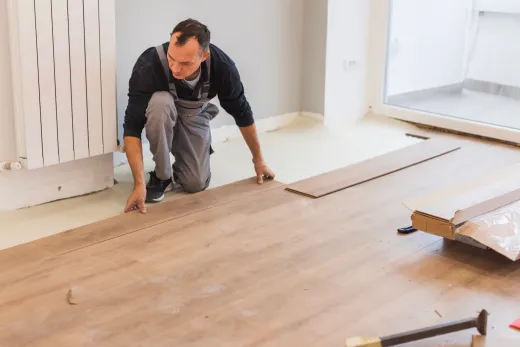
Removal is the line most homeowners forget to budget. Builder-grade laminate from a 2000s tower clicks apart in hours. Glued-down engineered hardwood fights back, and the parquet common in 1970s and 1980s buildings across North York and Scarborough was set in adhesive that has had fifty years to cure — expect a full day or more of scraping, plus disposal runs that each need the booked service elevator.
Slab condition is the other unknown under an old floor. Once the existing flooring is up, high spots and dips show, and floor levelling compound runs $3–$8 per square foot where it is needed. We flag both risks in the quote up front rather than discovering them as extras mid-job — in a condo, an extra levelling day also means another elevator booking and another day inside the building's 9-to-5 window, so surprises compound faster than they do in a house.
The Acoustic Underlay Premium: $2–$4 Per Sq Ft, Non-Negotiable
Nearly every Toronto condo board requires a sound-rated underlay before it will approve hard-surface flooring. The board's renovation package will specify minimum IIC or STC ratings, and management can — and does — ask for the underlay spec sheet before signing off. Budget $2–$4 per square foot in added material cost for a compliant product.
This is not a corner worth cutting. If the neighbour below complains after the fact and your underlay doesn't meet the declaration's standard, the corporation can order the floor lifted at your expense. We keep the spec sheet, the invoice and photos of the underlay going down on every condo job for exactly this reason. The full rules are covered in our answer on condo flooring and soundproofing requirements.
Board Approval Comes First: Timeline and Paperwork
No flooring work starts in a Toronto condo until the board approves it, and that process takes 4–10 weeks in most buildings. Expect to submit a written scope, the underlay specification, the contractor's insurance certificate and a work schedule.
Boards commonly require:
- $2M–$5M commercial general liability insurance with the condo corporation named as additional insured
- WSIB clearance for the contractor
- A refundable damage deposit, typically $1,000–$5,000, held against common-element damage
We handle this paperwork weekly, so the package goes in complete the first time — an incomplete submission is the most common reason a two-month approval becomes a three-month one. If your building predates the mid-2000s, it is also worth flagging plumbing era: many GTA condos built 1995–2007 contain Kitec piping, and boards pay close attention to any trade working near in-suite services.
Elevator Bookings, Deposits and Work-Hour Limits That Add Cost
Condo logistics are the hidden line item. Service-elevator bookings run $200–$500 per day, and a full reflooring needs several: demolition and disposal day, material delivery day, and often a final day for baseboards and touch-ups. Work hours are typically Monday to Friday, 9 a.m. to 5 p.m., with no weekends or holidays — which stretches schedules 20–30% compared with the same work in a freehold house.
Most buildings also prohibit wet-cutting in the unit, so tile and plank cutting happens on protected corridor stations or off-site, adding handling time. Corridors and elevators must be protected with board-approved materials, and hardwood refinishing in a condo runs roughly $0.50–$1.00 per square foot more than in a house because of access rules alone. We map these rules building by building before quoting — the details are in our answer on elevator bookings and condo working hours.
LVP vs Engineered Hardwood on a Condo Slab
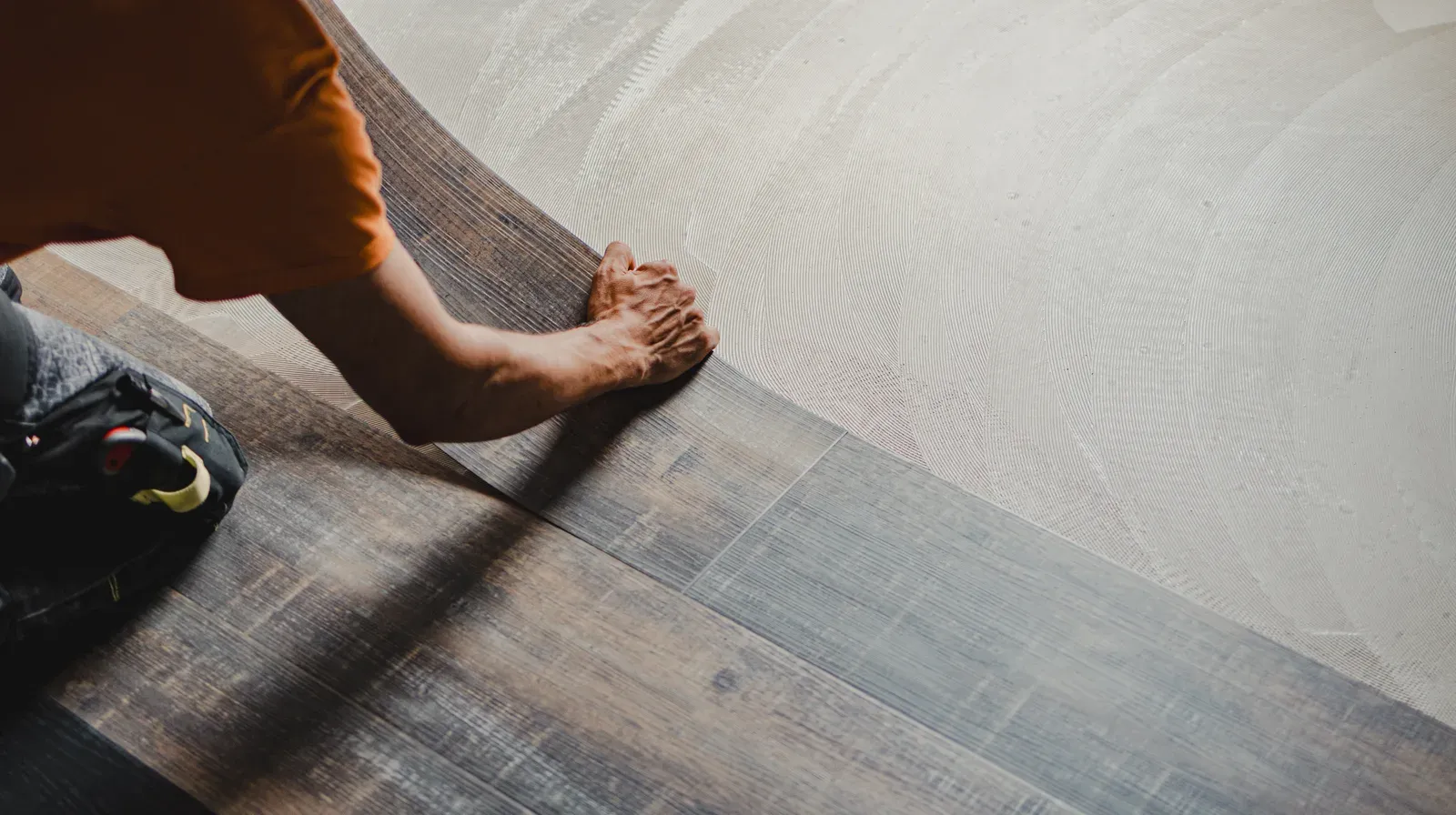
Almost every Toronto condo floor is a concrete slab, which rules out nailed-down solid hardwood and leaves two realistic choices. Luxury vinyl plank ($4–$9/sq ft installed) is fully waterproof, quiet over a good underlay, and forgiving of the minor slab humps common in 2000s towers along the waterfront and in North York. Engineered hardwood (roughly $7–$13/sq ft installed) glues or floats over concrete, reads as real wood to buyers, and handles the dry-winter, humid-summer swings of a high-rise better than solid boards ever could.
Our honest steer: engineered hardwood in the main living areas if the budget allows, LVP everywhere in units that will be rented. The differences are unpacked in engineered hardwood vs LVP.
Sample Budget: Reflooring a 700 Sq Ft Unit
For a typical 700 sq ft one-bedroom with LVP at mid-range pricing: flooring supply and install around $4,500–$6,000, acoustic underlay $1,400–$2,800, old-floor removal and disposal, new baseboards and transitions making up the balance — a realistic total of $8,000–$10,500 plus HST, in line with the $9,000 flooring line we see in full condo renovation budgets. Engineered hardwood pushes the same unit toward $11,000–$14,000.
Reflooring alone makes sense when the kitchen and bathroom are staying put. If you are also touching cabinets or tile, one combined board approval and one elevator schedule beats two separate projects — see our condo renovation service in Toronto for how we bundle scopes. Either way, start with the board package six to ten weeks before you want boots in the unit, and call us at (416) 995-7855 for a free quote through our Toronto flooring team.
Ready to start your renovation?
Our team is here to help you bring your vision to life. Get a free, no-obligation quote today.
Get Free QuoteFrequently Asked Questions
Clear answers to the questions Ontario homeowners ask most.