DIY vs Professional Bathroom Renovation: Where the Line Is
Some bathroom work is genuinely DIY-friendly. Some is regulated by Ontario law, and some fails expensively three years later. Here is where we draw the line after two decades of fixing both.
The Honest Split: What DIY Does Well
A full bathroom renovation in Toronto and the GTA typically runs $15,000 to $30,000 as of 2026, and labour makes up roughly a third of that budget. That sets the honest ceiling on DIY savings: do every piece of the work yourself, flawlessly, and you might keep $5,000 to $8,000. Get one step wrong behind the tile and you can spend more than that putting it right.
Some tasks sit safely on the DIY side of the line:
- Painting, caulking refreshes, and hardware — towel bars, hooks, mirrors, accessories
- Swapping a vanity or toilet in the exact same location, where the shutoff valves actually hold
- Sourcing your own tile and fixtures to trim the materials budget
- Demolition, with real caveats we cover below
These jobs are forgiving. A crooked towel bar costs you ten minutes. The trouble starts when homeowners extend that confidence to the systems buried in the walls — supply lines, drains, wiring, and waterproofing — where a mistake stays invisible until it shows up as a stain on the ceiling below.
Plumbing and Electrical: Where Ontario Rules Draw the Line
Electrical work in Ontario is not a judgment call. By law, only a Licensed Electrical Contractor — or you personally, in a home you own — may do electrical work, and every job needs a notification filed with the Electrical Safety Authority. The difference between an ESA permit and a building permit confuses a lot of homeowners: they are two separate systems, and a bathroom fan or new GFCI circuit falls under the ESA one. Filing as a homeowner costs more than a contractor pays — 2026 non-contractor rates run $64 to $340 for a residential renovation, and the work still gets inspected.
Plumbing has its own line. Replacing a faucet, toilet, or vanity in the same spot needs no permit anywhere in the GTA. The moment you move a drain, relocate the toilet, or add a new fixture, a building permit is required — and relocating plumbing typically adds $2,000 to $6,000 even when a pro does it, because drain slope, venting, and pipe routing all have to pass inspection. Unpermitted plumbing that leaks is also the kind of thing insurers ask pointed questions about.
Waterproofing: The Highest-Stakes Step in the Room
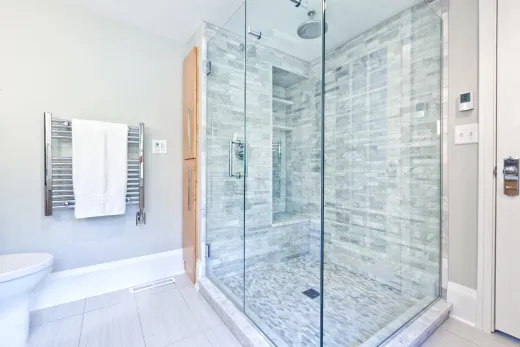
If we could only pick one task to keep out of DIY hands, it would be shower waterproofing. Tile is not waterproof. Grout is not waterproof. The membrane system behind the tile — sheet or liquid-applied, with sealed corners, a properly sloped pan, and a flood test before tile goes on — is the only thing standing between your shower and the framing. We wrote a full breakdown of how a shower should be waterproofed, and the short version is that the steps are unforgiving and mostly invisible once tile covers them.
When we open up failed showers across the GTA, the pattern repeats: tile applied straight over drywall or unsealed cement board, no pre-slope under the pan, niches cut in after the membrane went up. The tile job often looks fine for two or three years. By the time the subfloor is soft, the fix is a full tear-out. Professional tile setters in Toronto charge $80 to $125 an hour, or $8 to $15 per square foot — against a $10,000-plus rebuild, that labour is the cheapest insurance in the room.
The Real Cost Math: Tools, Time, and Redos
DIY math usually compares the pro quote against materials alone. The honest comparison includes three more columns.
Tools first. A tile saw worth using, levelling systems, trowels, a proper mixing drill, waterproofing kit — call it several hundred to over a thousand dollars for equipment you may use once. Time second. Our crews finish a standard 3-piece bathroom in two to three weeks. The same scope done on evenings and weekends routinely stretches two to three months, and your household is down a bathroom the whole time.
Redos are the column nobody budgets. GTA trade rates as of 2026 — plumbers at $110 to $200 an hour, licensed electricians at $95 to $150 — apply whether the trade is building new or undoing your work first, and correction calls usually involve both. A typical bathroom tiling job alone runs $2,500 to $8,000; if it has to come off because the waterproofing underneath failed, you pay for demolition, new membrane, and new tile. One more line for your spreadsheet: contractor quotes in Ontario usually exclude 13% HST, so compare DIY and pro numbers on the same basis.
The Hybrid Approach: Homeowner Demo, Pro Build
There is a middle path we genuinely like: you handle demolition and painting, we handle everything wet, wired, and structural. Done right, it trims real money off the labour line without touching the high-stakes steps.
One serious caveat before you pick up a sledgehammer. If your home was built before about 1990, materials in that bathroom may contain asbestos — drywall compound, vinyl floor tile, plaster, textured ceilings were all common carriers, and testing is the only way to know. Lab testing runs a few hundred dollars; disturbing asbestos without knowing costs far more, in every sense. This applies to a huge share of GTA stock: 1950s and 60s Etobicoke bungalows, 1960s–70s Scarborough back-splits, and pre-war Toronto semis all fall in the window.
If the test comes back clean, agree on the handoff with your contractor in writing: demo down to studs and subfloor, debris out, shutoffs closed, and a firm date. A half-finished demo that stalls the crew erases the savings fast.
When Full-Service Makes Sense
Keep it DIY when the scope is cosmetic: paint, hardware, a same-spot vanity swap, maybe your own demo after an asbestos check. Go hybrid when you have time, a second bathroom to live out of, and a contractor willing to sequence around you.
Go full-service when any of these apply: fixtures are moving, the shower is being rebuilt, the house predates 1990, it is your only bathroom and downtime matters, or the scope has crept to the point where three or four trades need coordinating. That coordination is most of what you are paying a contractor for — our bathroom renovation service runs plumbing, electrical, waterproofing, and tile as one sequenced schedule, with permits handled and a 2-year workmanship warranty behind the result.
Before you decide either way, put real numbers on the pro option. Our guide to what a bathroom renovation costs in Toronto breaks the budget down line by line, and a free quote tells you exactly what the labour you are considering doing yourself is actually worth.
Ready to start your renovation?
Our team is here to help you bring your vision to life. Get a free, no-obligation quote today.
Get Free QuoteFrequently Asked Questions
Clear answers to the questions Ontario homeowners ask most.