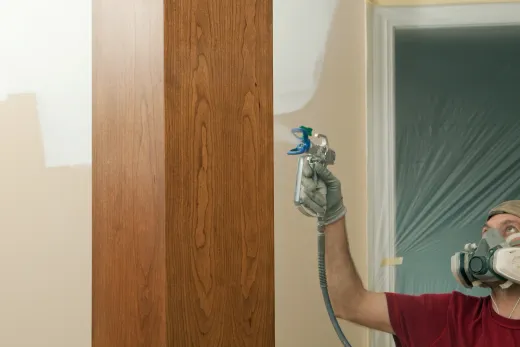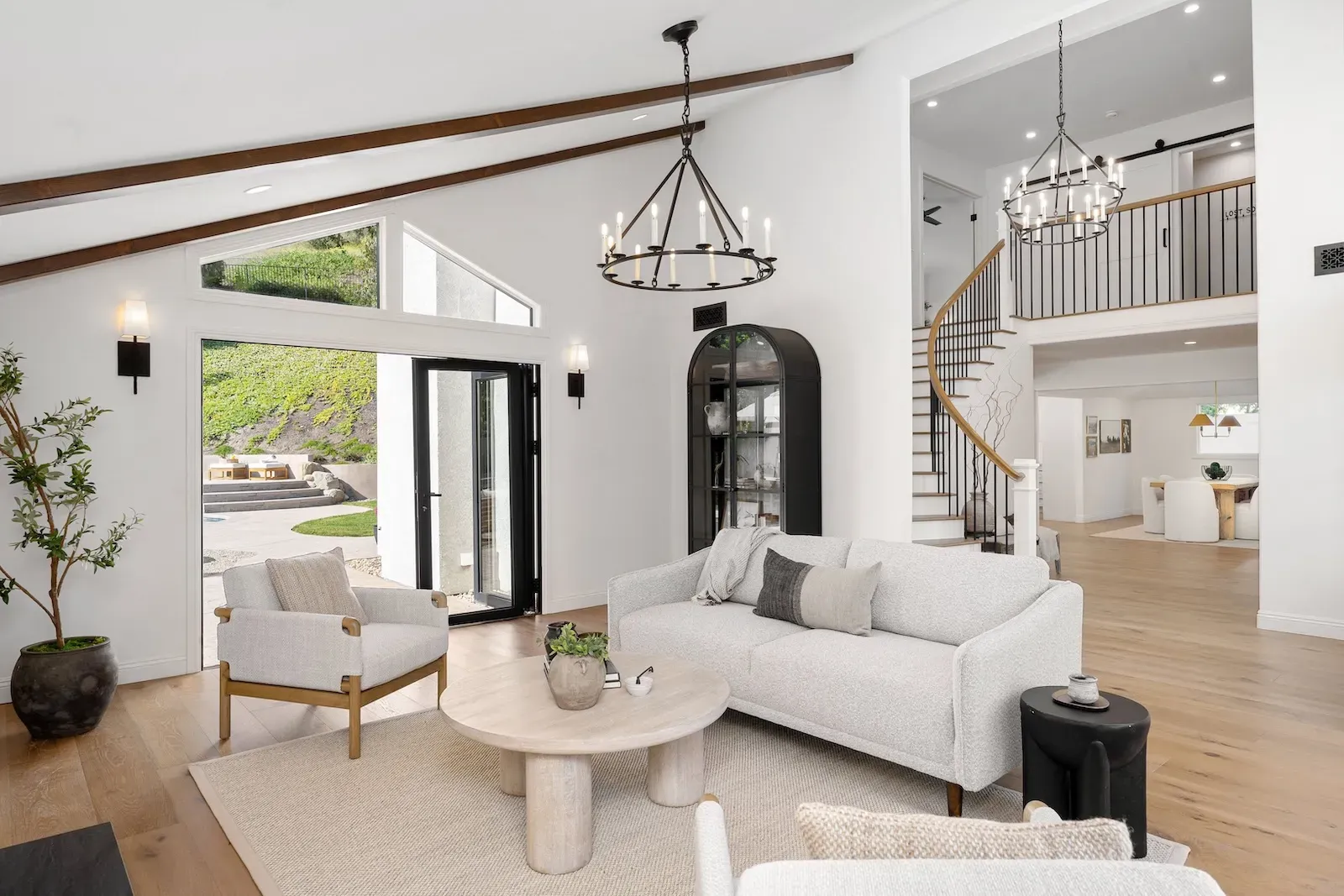
A two-storey foyer holds double the wall area of a normal room, and every square foot of it is harder to reach. Here is how GTA painters price tall spaces in 2026 — and how to keep the bill sensible.
Why High Spaces Cost More Than Their Square Footage
GTA painters price by wall area, not floor area. Whole-home repaints run roughly $1.80–$4.50 per square foot of wall surface as of 2026, before HST, and ceiling height is one of the biggest drivers within that band. A two-storey foyer with 17 or 18 feet of height packs 300–600 square feet of wall into a footprint smaller than most bedrooms — so paint alone lands around $800–$2,700 at standard rates, and tall spaces sit at the top of the band because of the access work.
The height premium is real, not padding. Every cut line at the ceiling happens from a plank or scaffold instead of a step ladder. Every pass with the roller uses an extension pole, which slows coverage and demands more skill to keep the film even. And single-space jobs carry the same setup, masking, and cleanup as a small room, which is why standalone rooms price closer to $5 per square foot of wall area than the whole-home rate.
Builder subdivisions across the GTA are full of these spaces — the two-storey foyer became a standard feature in the mid-1980s and stayed one for two decades. If your home went up in Oakville's Glen Abbey, Richmond Hill's Bayview Hill, Vaughan's Maple, or Milton's post-2001 neighbourhoods, odds are good you have at least one wall no ladder in your garage can reach safely.
Staging, Planks, and Scaffolds: How Pros Reach
There are three standard ways a crew reaches an 18-foot wall, and the right one depends on what is underneath it.
- Extension ladders with standoff stabilizers — for straightforward open walls with solid, level flooring below.
- Ladder-and-plank staging — two ladders (or a ladder and a stair-specific leveller) carrying an aluminum plank, which is how most stairwell walls get painted.
- Interior scaffold towers — rolling baker-style scaffolds for great rooms and foyers where a full day or more of work happens overhead: repairs, cutting, rolling, and often a light fixture swap.
The stairwell is where DIY goes wrong most often. Leaning an extension ladder against a wall above a descending staircase puts the base on two different stair treads, and improvised solutions — a ladder foot on a stack of books, a plank on a railing — are how people end up in the emergency room. Professional crews carry levelling legs and rated planks because a fall from 12 feet onto hardwood stairs is not a risk worth a saved service call. That equipment, and the time to set it up and tear it down, is baked into a proper quote.
What Two-Storey Foyers and Great Rooms Typically Cost
Because pricing follows wall area and access, here is how the math typically works out in the GTA as of 2026, before HST.
A modest two-storey foyer — the entry, the stairwell wall, and the upper hallway sightline — usually carries 300–450 square feet of paintable wall. At tall-space rates with staging included, most land in the low four figures as a standalone job. A large foyer that wraps the staircase and open hallway, or a great room with a vaulted ceiling and a full-height fireplace wall, can double that area and the price with it.
A few things push the number up further. Going from a dark builder beige to a light colour means an extra coat across the full height — dark-to-light changes are one of the most common surprises on painting quotes. Ceilings, trim, railings, and doors are almost always priced separately, so read the quote carefully to see what "foyer" actually includes. And popcorn or textured surfaces up high need either careful cutting or removal, which is a different scope entirely.
This is one reason quotes for the same space vary between contractors: one painter is pricing a wall-only refresh from ladders, another is pricing full staging, repairs, ceiling, and trim. Neither is wrong — they are quoting different jobs.
Colour Strategy for Tall Walls and Sightlines
Tall spaces punish indecision. In a normal bedroom, a colour you regret costs a weekend to fix. In a two-storey foyer, redoing it means paying for the staging all over again — so it is worth getting the colour decision right before anyone opens a can.
The technical problem is that foyer walls rarely end where you want them to. An open-concept main floor often flows from the entry into the hallway, up the stairwell, and across the second-floor landing with no inside corner to stop a colour at. Pick a colour for the foyer and you may have committed the whole circulation spine of the house to it. The clean solutions are to carry one colour through the entire connected volume, or to stop at a deliberate architectural break — a bulkhead, a change in wall plane, or trim installed to create one.
Lighting matters more up high, too. Tall walls take raking light from second-storey windows and foyer fixtures, which exaggerates every roller mark and drywall imperfection. Slightly deeper or warmer tones in a flat or matte sheen are more forgiving on big uninterrupted surfaces than bright whites in anything glossier. We sample large swatches at both floor levels before committing, because a colour that reads soft at the front door can look washed out from the landing.
Fixtures, Repairs, and Ceilings While the Staging Is Up
The scaffold rental and setup time cost the same whether you use them for one task or five. Smart homeowners batch the high-access work into one visit.
The most common add-on is the foyer light fixture. Swapping a dated chandelier is a quick job from a scaffold that is already standing, and a miserable one from a ladder over the stairs any other day. The same goes for smoke detector replacement on tall ceilings, cleaning or repainting ceiling vents, and repairing the settlement cracks that show up where tall walls meet ceilings in 1980s–2000s builds.
Drywall work up high is worth doing properly while access exists. Taping and mudding repairs run roughly $1.75–$3.75 per square foot in the GTA, and if a tall feature wall takes hard raking light, a full skim coat — a Level 5 finish — adds about $1.00–$1.50 per square foot over a standard finish and makes a visible difference on a surface you see from three angles. As part of a broader home renovation, we sequence this so the drywall crew and painters share the same staging window instead of billing two setups.
One caution: fixture swaps involving new wiring or a new box location are electrical work, which in Ontario means a licensed electrical contractor and an ESA notification — not something to hand the painter.
When to Bundle High Spaces Into a Bigger Job
The standalone foyer paint job is the most expensive way to buy this work. Setup, masking, staging, and cleanup are fixed costs, so the effective rate drops fast as scope grows — bundling three or more rooms typically cuts per-room pricing by 15–25%, and full repaints price at the low end of the $1.80–$4.50 range.
Our honest guidance:
- Paint the foyer alone if it is genuinely the only tired space, or if damage (a leak stain, peeling tape lines) makes it urgent.
- Bundle it with the connected spaces — hallway, landing, stairwell — almost always. They share walls and sightlines with the foyer, and painting them separately later means paying for staging twice.
- Fold it into a whole-home repaint if you are within a year or two of doing one anyway. The foyer premium nearly disappears inside a full-house scope, and the colour-continuity problem solves itself.
If you are budgeting a larger project around it, our guide to what home renovations cost in Toronto covers how painting fits alongside the bigger line items. And if you want a firm number for your own foyer, send us photos and rough ceiling heights through our contact form — tall spaces quote accurately from good photos, and quotes are free.
Ready to start your renovation?
Our team is here to help you bring your vision to life. Get a free, no-obligation quote today.
Get Free QuoteFrequently Asked Questions
Clear answers to the questions Ontario homeowners ask most.