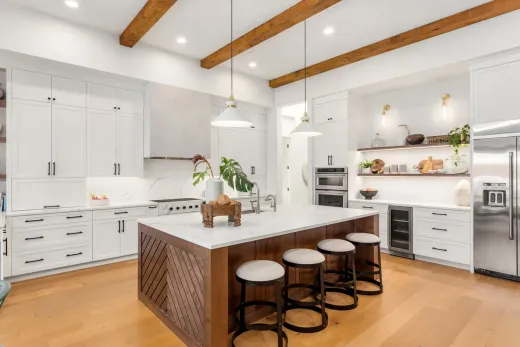
A kitchen island can be a simple cabinet run with a quartz top or a full workstation with sink, power and seating. Here is what each level costs in the GTA in 2026.
Kitchen Island Costs in the GTA at a Glance
Most cabinet-built islands with a stone countertop land between roughly $4,000 and $10,000 installed in the GTA as of 2026. Add a sink, dishwasher or cooktop and the project graduates: plumbing relocation, new circuits, permits and inspections push full-service custom islands to $10,000–$15,000 and beyond.
The build-up is straightforward, because an island is priced from the same line items as the rest of the kitchen:
- Base cabinets: $150–$400 per linear foot stock, $300–$900 semi-custom, $800–$1,500+ custom
- Countertop: quartz at $75–$140 per square foot installed; waterfall edges add $500–$2,000
- Electrical: receptacles and circuits at electrician rates of $95–$150 per hour, plus an ESA notification that typically runs $90–$300 on a kitchen project
- Plumbing, if the sink moves: a building permit plus real mechanical work — kitchen plumbing scopes run $1,000–$8,000
The sections below price each path, and the planning rules that decide whether an island fits your kitchen at all.
Prefab, Cabinet-Built or Full Custom: Price Ranges
Freestanding prefab islands are furniture: they sit on the floor, connect to nothing, and retail anywhere from a few hundred dollars to a few thousand. They suit renters and anyone testing whether an island fits their cooking habits before committing. They are also small — most are work-table depth, not the seating-and-storage hub people picture from renovation photos.
Cabinet-built is the standard renovation approach: base cabinets anchored to the floor, finished panels on the exposed sides, and a countertop on top. A typical island uses 6–8 linear feet of cabinetry, so the math runs about $1,000–$3,000 in stock boxes or $2,000–$7,000 in semi-custom, plus the top. With quartz included, most land in that $4,000–$10,000 all-in band.
Full custom adds what production cabinets cannot: furniture-style ends, deep seating overhangs with concealed support, integrated wine storage or panel-ready appliances, and non-standard dimensions. Custom cabinetry at $800–$1,500+ per linear foot puts these islands at the top of the range before any services are added.
Adding a Sink, Power or Seating: What Services Cost
Power is the manageable one. Island receptacles mean new circuits, and any new circuit needs an ESA notification filed by your licensed electrical contractor — a separate system from municipal building permits, explained in ESA electrical permit vs building permit. With GTA electricians at $95–$150 per hour and the notification usually built into their quote, powering an island is typically a small line on the budget.
Moving the kitchen sink into the island is the expensive decision. It requires a building permit because supply and drain lines are being relocated, and the drain needs proper venting under the island — not always simple over a finished basement ceiling or on a slab. Kitchen plumbing scopes run $1,000–$8,000 depending on how far services travel, and a dishwasher beside the island sink rides on the same rough-in. We cover the realities in moving the kitchen sink and appliances.
Seating costs little beyond the countertop overhang and its support — but it changes the island's size, since every stool needs real width and the overhang eats into aisle space. That brings us to clearances.
Countertops and Waterfall Edges for Islands
Island tops carry the room visually, and they price by area like any counter. Quartz installs at $75–$140 per square foot in the GTA; a typical island top of 20–25 square feet works out to roughly $1,800–$3,500. Granite covers a similar band at $75–$175 per square foot installed.
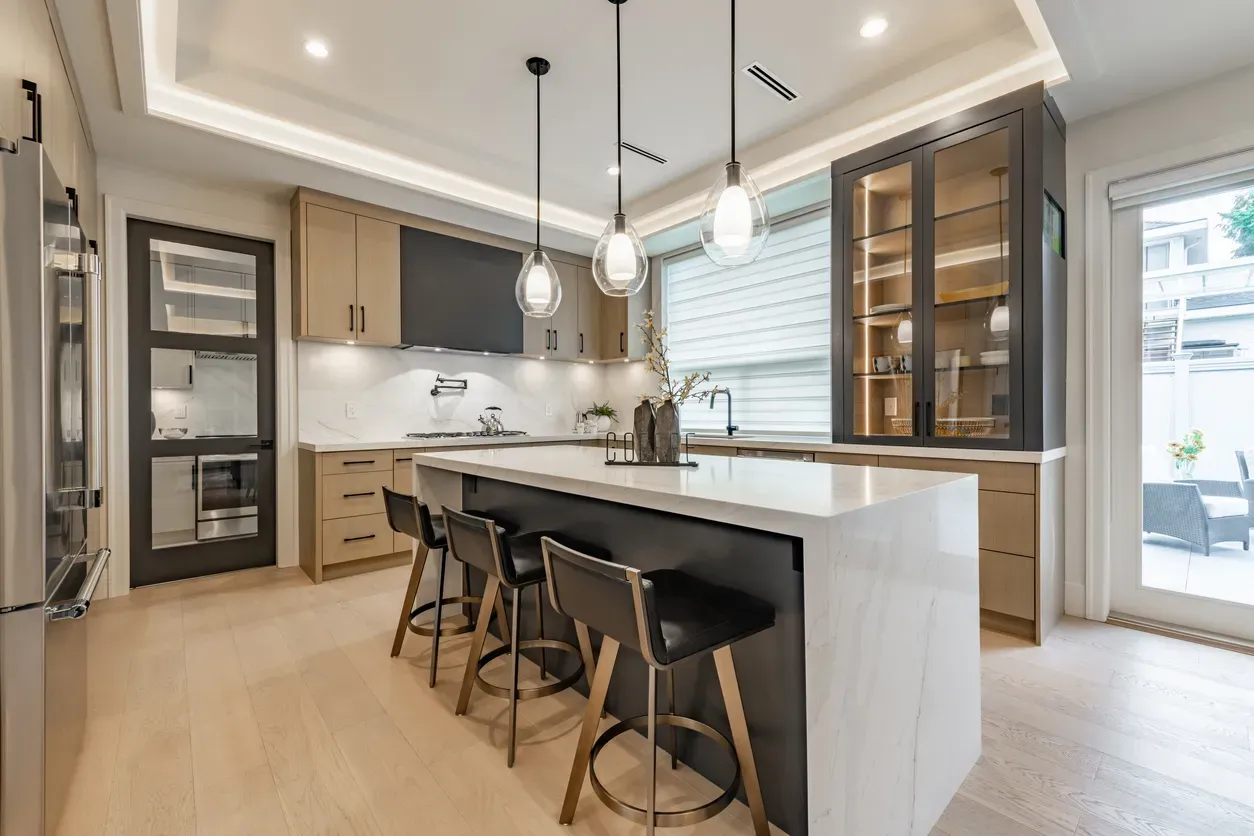
Waterfall edges — the stone continuing down the island's sides to the floor — add $500–$2,000, and full kitchens that include an island with premium edging commonly reach $7,000–$10,000+ in total countertop spend.
Two practical notes from installations. Large islands can exceed standard slab dimensions, forcing a seam — decide where it goes before fabrication, not after the slab shows up. And seating overhangs need proper brackets or steel support; a stone top that cracks at the overhang is an expensive lesson in skipped hardware.
Clearances and Space: Will an Island Actually Fit?
The most common island mistake in GTA homes is not price — it is fit. Our working rule on site: leave roughly 42 inches of aisle on every working side of the island, and more where two people cook or where the dishwasher door swings into the walking path. Once you subtract those aisles, a kitchen generally needs to be around 12 feet across before a standard-depth island with seating sits comfortably.
Tighter kitchens still have options — a narrower island, a shorter run, or a peninsula that borrows one wall — but forcing a full island into a galley-width space makes a kitchen worse every single day you use it. Older GTA housing in particular, from wartime bungalows to Victorian semis, often suits a peninsula far better than the island the inspiration photos show.
Before you fall for a design, measure honestly. Our answer on whether your kitchen fits an island walks through the exact measurements we check before drawing one in.
Permits, ESA and Timing Within a Bigger Reno
The permit picture is simple. A dry island — cabinets, counter, seating — needs no building permit anywhere in the GTA. Receptacles or new circuits need only the ESA notification. Move plumbing and you need a building permit; in Toronto, real-world renovation permit packages run roughly $700–$3,500 all-in, and review takes weeks rather than days, so plan the schedule around it.
Timing is the bigger lever on value. Adding an island during a full kitchen renovation costs meaningfully less than adding one later: flooring runs under the island once instead of being patched around it, plumbing and electrical rough-ins happen while everything is open, and the fabricator templates all the counters in one visit. As a standalone project, a dry island is a clean, contained job; a wet island on its own means opening floors, which rarely makes sense outside a larger renovation.
Our decision guidance: if the budget stops near $5,000, build a dry semi-custom island with quartz and add power. If the layout genuinely justifies a sink move, fold it into a bigger project. Full budget context is in our kitchen renovation cost guide — and we quote both versions free, so you can see the gap before deciding.
Ready to start your renovation?
Our team is here to help you bring your vision to life. Get a free, no-obligation quote today.
Get Free QuoteFrequently Asked Questions
Clear answers to the questions Ontario homeowners ask most.