Vaughan's housing stock is young, but its staircases aren't aging well — honey oak, chunky spindles, carpet runners from the builder. Here are the 2026 updates that work, with honest budgets for each.
The Vaughan Starting Point: 1990s-2000s Builder Oak
Vaughan built out late. The city barely had 15,000 people until trunk sewers arrived in the late 1970s; Woodbridge and Thornhill filled in through the 1980s and 90s, and Maple, Sonoma Heights and Vellore Village followed in the 1990s and early 2000s. That means most staircases we see here — right from our shop at 7700 Keele — are the same staircase: honey-toned oak treads or carpet-over-plywood, turned wood spindles, a bulky oak handrail, and a finish that has gone orange with two decades of ambered polyurethane.
The good news is that this vintage of staircase is structurally excellent. Builders in Maple and Woodbridge in that era used solid stringers and generous widths, so almost every update on this list works with the bones you already have. Nobody needs to tear a Vellore Village staircase out to modernize it — and as of 2026, the popular updates run from about $3,500 for a refinish-and-picket project to $5,500 and up for a full recap with new railings.
Dark Treads, White Risers: The Reliable Modern Formula
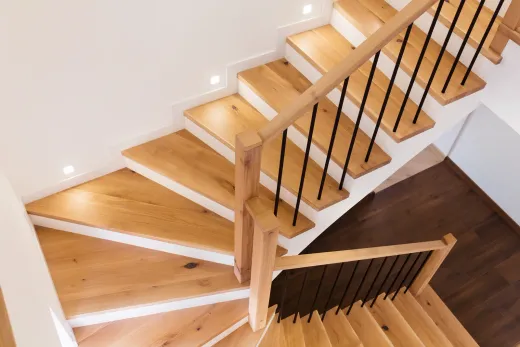
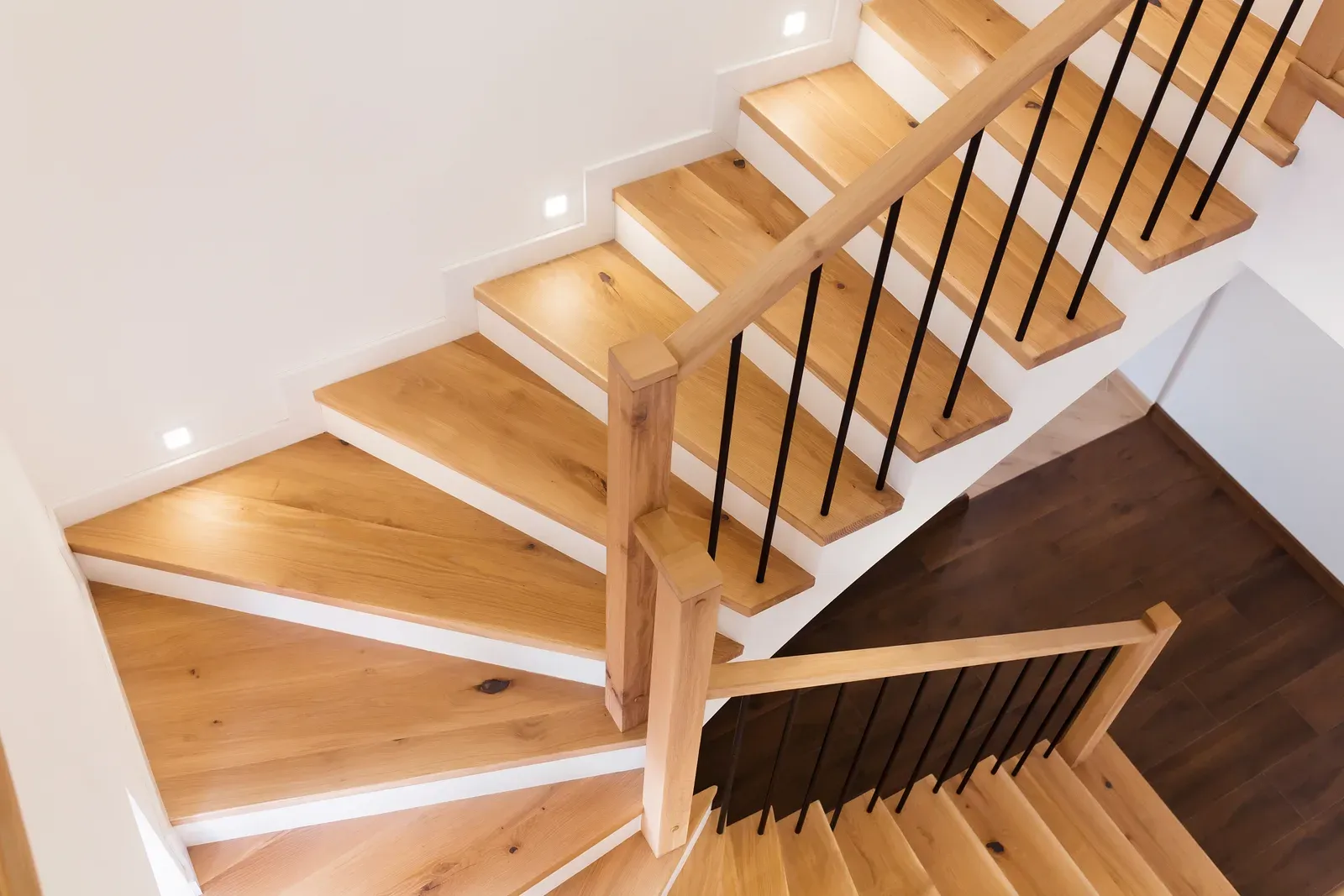
The single most requested look in our Vaughan projects is dark treads over crisp white risers — espresso, dark walnut or a cooler mid-brown on the horizontal surfaces, painted risers and stringers below. It photographs beautifully against the pale wide-plank floors going into GTA homes right now, and it hides the orange undertone of 1990s oak completely because the pigment overwhelms it.
Two ways to get there. If your treads are solid oak in decent shape, refinishing is the budget route: sand to bare wood, stain dark, seal with a water-based finish that won't re-amber. At $50–$125 per step, a typical 13-step staircase lands roughly $650–$1,600 for the steps, with project minimums around $3,500 once railing work joins in. If the treads are worn, chipped or carpet-grade material, recapping — new solid oak treads and risers installed over the existing structure — starts around $185 per step for straight stairs and $225 for pie steps, with projects typically from $4,900.
A matte or satin sheen is worth specifying either way. Gloss shows every dust particle and footprint on a dark tread; satin forgives daily life.
Iron and Steel Picket Swaps: Big Look, Contained Budget
If the budget only allows one move, swap the turned oak spindles for metal. Slim matte-black iron pickets — straight bars, or bars with a single square collar — instantly pull a 1998 staircase into this decade, and the work is contained: pickets come out, new ones set into the existing handrail and shoe rail, holes filled and touched up. Most picket swaps happen inside the $3,500-minimum project tier rather than requiring the full $5,500-plus railing rebuild.
Go further and replace the handrail and newel posts too: a modern flat-profile rail with square posts, paired with a recap, typically starts around $5,500 for a 13-step staircase. That is the full transformation — new treads, new rail, new pickets — for less than many Vaughan homeowners spend on a single appliance.
One practical note from installs across Sonoma Heights and Thornhill: black metal shows dust less than people fear, but skip high-gloss powder coats near front doors. Winter grit and boot traffic are hard on shiny finishes; matte and textured coats wear far better through a GTA freeze-thaw season of salt and slush at the foyer.
Glass and Open-Riser Looks: What They Cost and What Code Says
Glass panel railings deliver the most dramatic modernization — sightlines open up, light from a second-storey window reaches the main floor, and the staircase reads as architecture instead of millwork. They are also the premium option: tempered panels, standoff hardware and precise fitting put glass railing projects well above standard picket pricing, and we quote them individually after measuring.
Open risers — treads with visible gaps between them — are the other look Vaughan homeowners bring us from design feeds. Here the Ontario Building Code has opinions. Guards and openings on stairs are regulated so that small children can't slip through or get caught, which limits how "open" a residential staircase can legally be. Fully floating looks usually need thicker treads, partial risers or careful gap detailing to comply, and structural changes to achieve them turn a cosmetic project into a permit-and-engineering project. We flag this early because it is the difference between a five-day recap and a multi-week rebuild.
An honest middle path: keep closed risers, paint them a deep charcoal to visually recede, and put the budget into glass or a sculptural newel instead.
Lighting, Runners and Landing Details
The finishing layer is where staircases in newer Vaughan homes go from updated to genuinely custom. Recessed LED step lights — small pucks or linear strips washing each tread — are best planned during railing work while an electrician can fish wires cleanly; remember any new circuits need an ESA electrical notification, which your electrician files. A wall-mounted dimmable fixture over a landing does half the job for a fraction of the cost.
Runners are back, and not the floral 1990s kind: flat-weave wools and geometric patterns in charcoal, rust and cream. On dark stained treads a runner adds traction for kids and older parents — a real consideration in multigenerational Woodbridge households — and protects the finish on the wear path. Fit it two to three weeks after finishing so the coats cure fully.
Landing details worth the small upcheck: a waterfall-wrapped landing tread in the same oak as the stairs, flush transitions into upstairs flooring, and paint-matched skirt boards. These are the details people can't name but always notice.
Phasing a Staircase Makeover With Flooring Updates
Stairs rarely travel alone. Most of our Vaughan staircase projects happen alongside main-floor flooring — and the sequence matters. Flooring goes first, stairs second, so tread stain is matched against the actual installed floor rather than a sample board. Get the order wrong and the stain match is a guess.
If you are phasing over a year or two, here is the split that works: do flooring and stair recapping together (the wood arrives and acclimatizes as one order, and flooring projects start around $5,000 with solid hardwood at $8–$15 per square foot installed), then do railings, pickets and lighting as phase two. What doesn't work is finishing stairs first and flooring later.
When to pick which route: refinish if your oak is sound and the profile suits you; recap when treads are tired or carpeted; go glass or rebuild only when the design genuinely demands it. Our flooring team in Vaughan handles stairs and floors as one scope, and every project carries our 2-year workmanship warranty. See what we install day to day under hardwood flooring installation, or request a free quote — one site visit covers stairs and floors together.
Ready to start your renovation?
Our team is here to help you bring your vision to life. Get a free, no-obligation quote today.
Get Free QuoteFrequently Asked Questions
Clear answers to the questions Ontario homeowners ask most.