A squeak is wood moving against wood — or the nail meant to hold it. Here is where stair squeaks come from, how we silence them for good, and what repairs cost across the GTA in 2026.
Why Stairs Squeak: Wood Movement at Treads and Stringers
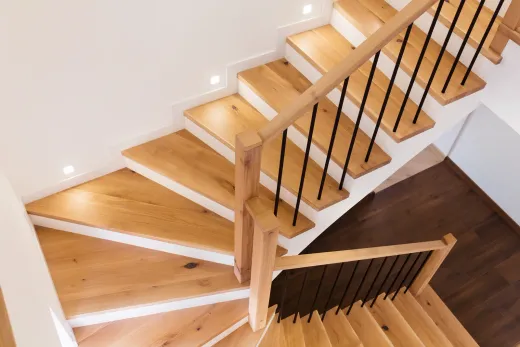
A squeak is movement. Every wood staircase is a sandwich of treads, risers, wedges and stringers held together with glue, nails and friction. When any joint loosens enough for parts to rub — wood against wood, or a tread sliding up and down a nail shank — you hear it on every step.
The GTA climate does most of the loosening. Humid summers swell the lumber; then six months of forced-air heating dries it out and shrinks it. Repeat that cycle for twenty years and glue joints crack, wedges back out of their pockets, and nail holes wallow open. That is why squeaks tend to appear or get worse in January, not July.
Age matters less than people assume. We hear squeaks in 1960s Scarborough back-splits, in Victorian semis in Riverdale, and in Milton subdivisions built after 2001. Newer homes squeak too, because framing lumber keeps drying and shrinking for the first few years after closing — the same process behind nail pops and settlement cracks. The good news: the fix is the same whether the house is five years old or a hundred and five.
Finding the Squeak: Top Access vs Underside Access
Before quoting a repair, the first thing we check is whether the underside of the staircase is open. Basement stairs in most GTA homes are unfinished below, which makes them the cheapest stairs in the house to fix — we can see exactly which wedge or glue block has let go and work on it directly without touching any finished surface.
Main staircases are usually the opposite. In a typical two-storey home the underside is drywalled, and in older Toronto houses it is often plastered and sometimes hides a closet ceiling. Nobody wants that opened up for a squeak, so we work from the top instead: walking each step, flexing the tread by hand, and marking exactly where it moves — front edge against the riser, or the ends where the tread meets the stringers.
Carpeted stairs add one more wrinkle. The carpet muffles the diagnosis and hides the fasteners, but it does not make repair impossible; it just changes the technique, as covered below.
Pro Fixes: Screws, Wedges, Adhesive and Blocking
Talcum powder, lubricant sprays and "stair squeak" gimmick kits are temporary — they quiet the rub without stopping the movement. A permanent fix re-fastens the joint. Depending on access, that means:
- From below: re-glue and re-seat loose wedges, add glue blocks at the tread-riser joint, and screw cleats or blocking where the original fasteners failed. This is the gold-standard repair when the underside is open.
- From above: drive trim-head screws through the tread into the riser and stringers, countersink them, and fill or plug the heads. On stained oak treads we plug with matching wood so the repair disappears.
- Through carpet: specialty breakaway screws grip the tread through the pile, then snap off below the surface — no need to lift the carpet.
- Into gaps: construction adhesive worked into an open tread-riser joint bonds the parts so they stop rubbing.
A competent repair also addresses why the joint failed. If a stringer has pulled away from the wall framing, screwing one noisy tread is treating the symptom.
What Squeak Repairs Cost in the GTA
A standalone squeak repair is small-job territory. Most contractors, us included, price it after a site visit or photos rather than off a rate card, because the number depends almost entirely on access: an open-backed basement staircase might be an hour or two of work, while a plastered main staircase with carpeted treads takes more care. Expect minor-works pricing with a minimum charge, and remember quotes typically exclude 13% HST.
The per-step economics get much better when squeak repair rides along with bigger stair work. As of 2026, Toronto stair refinishing runs roughly $50–$125 per step, so a typical 12–13 step staircase lands around $600–$1,625 for the refinishing itself, with realistic project minimums near $3,500 once railings and posts are in scope. Recapping — new solid oak treads and risers installed over the existing structure — starts around $185 per step for straight treads and $225 for pie steps, with typical projects from $4,900.
For context on how stair work fits into broader flooring budgets, see what flooring projects cost in Toronto.
The Ideal Timing: Fix Squeaks During Refinishing or Recapping
If your stairs are worn as well as noisy, do not book two projects. The best time to eliminate squeaks permanently is when the treads are already being worked on.
During refinishing, the treads are sanded bare, which lets us screw and plug every loose joint before stain goes down — the repairs vanish under the new finish. During recapping, squeak elimination is essentially built in: every new tread is glued and fastened fresh over the old structure, so the loose original joints stop carrying foot traffic at all. We treat re-fastening the existing steps as part of prep, not an extra.
The same logic applies if you are replacing flooring upstairs or down. Matching new stair finishes to adjacent floors is easier when one contractor handles both — stain colour, sheen and transition details all get decided together. It is a conversation we have constantly on hardwood flooring installation projects where the staircase connects two freshly finished storeys, and it beats discovering the stairs read orange next to your new white oak.
When Squeaks Signal a Structural Problem
Most squeaks are cosmetic annoyances. A few are early warnings. Book an assessment promptly if you notice a tread that visibly deflects or feels spongy underfoot, a gap opening where the staircase meets the wall, a cracked or split stringer visible from below, or movement at the landing rather than a single step. In back-splits and older semis, stairs sometimes share framing with walls that have been modified over the years — we occasionally find stringers cut or notched during old ductwork or wiring jobs, which is a structural repair, not a squeak fix.
Seasonal movement elsewhere in the house can point the same direction; if your floors are gapping and creaking too, read why hardwood floors cup and gap — the humidity swings driving both are identical.
The practical decision tree: one or two squeaky steps with open underside access, book a small repair. A whole staircase that is noisy and worn, price refinishing or recapping and get the squeaks fixed inside that project. Anything that moves, bounces or separates, have it inspected first. We have been repairing GTA staircases since 2004 and back the work with a 2-year workmanship warranty — request a free quote and send photos of the underside if you have access.
Ready to start your renovation?
Our team is here to help you bring your vision to life. Get a free, no-obligation quote today.
Get Free QuoteFrequently Asked Questions
Clear answers to the questions Ontario homeowners ask most.