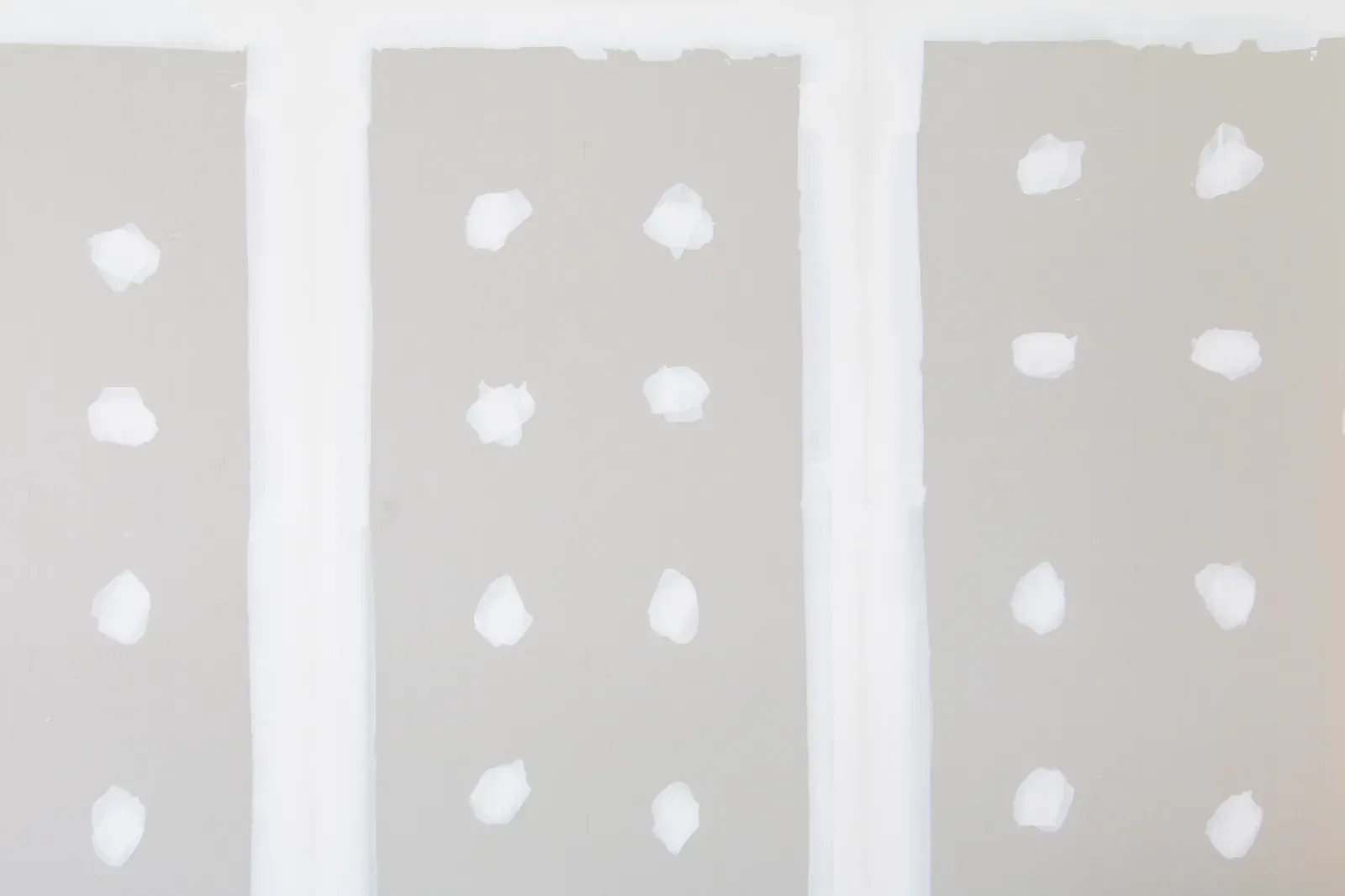
Half the failed showers we demolish in the GTA come down to the wrong board in the wrong place. Here is which drywall belongs where in a bathroom or basement, and why the shower is different.
The Board Menu: Regular, Moisture-Resistant, Mould-Resistant, Cement
The rules we build to are simple. Inside a shower or tub surround: cement board or a foam board system under a waterproofing layer — never any kind of drywall. Bathroom walls and ceilings outside the wet zone: moisture-resistant or mould-resistant board. Basements: mould-resistant board over a properly managed foundation wall. Regular drywall: everywhere else.
The products differ in what they sacrifice to water. Regular drywall is a gypsum core faced with paper — and paper is food for mould the moment it stays damp. Moisture-resistant board, the classic green board, adds water-repellent additives to the paper and core; it shrugs off humidity but still fails under direct soaking. Mould-resistant boards — often purple-faced — go further, replacing or treating the paper facing so there is nothing for mould to eat. Cement board contains no gypsum and no paper at all; it does not soften, swell, or feed mould even when saturated, which is why it is the tile backer of choice in wet zones.
None of these boards is waterproofing. They are substrates that tolerate moisture while a separate membrane or vapour strategy does the actual water management.
Shower Surrounds: Why Cement Board or Foam Rules
A GTA family shower sees hot, saturated air and direct spray every day, and tile plus grout is not a waterproof layer — water vapour and small amounts of liquid get through. Whatever sits behind the tile has to survive that reality for decades. Green board behind shower tile was accepted practice a generation ago; we still open up 1980s and 90s ensuites in Markham and Mississauga and find the result — soft, black-streaked board, rusted screws, and tile held up mostly by habit.
Current practice is cement board or a purpose-made foam board, with a dedicated waterproofing layer over or integral to it. On cement board that means a liquid-applied or sheet membrane such as Schluter's system; foam panels arrive waterproof and need only sealed seams and fasteners — the layering logic behind any properly waterproofed shower. Cost is a non-argument: cement board runs roughly $4–$7 per square foot installed as an underlayment, and membranes about $5–$12 per square foot — a small line inside what a full bathroom renovation costs in Toronto, and trivial next to demolishing and redoing a failed shower five years in.
Bathroom Walls and Ceilings Outside the Wet Zone
Outside the direct-spray zone, drywall is fine — the question is which one. Our default in any bathroom we renovate is mould-resistant board on every wall and the ceiling. The upcharge is real but small at bathroom scale: standard 4x8 sheets retail around $11–$15 while moisture-resistant sheets run roughly $24–$30, and a typical GTA bathroom needs only eight to twelve sheets. Call it a couple hundred dollars of insurance on a room that gets steamed twice a day.
Ceilings deserve specific attention. Warm, humid air stacks at the ceiling, and in winter that surface is often the coldest plane in the room — especially under an uninsulated attic in a 1950s or 60s bungalow in Etobicoke or Scarborough. Condensation forms, and regular painted board eventually shows peeling paint and grey speckling. Moisture-resistant board plus proper ventilation solves it; a correctly sized exhaust fan vented outdoors — not into the attic — matters more than any board choice.
One framing note: some moisture-resistant ceiling boards want closer joist spacing to prevent sagging. Board selection and framing get decided together, which is one reason bathroom board swaps belong inside a planned bathroom renovation, not an afterthought.
Basements: Moisture Comes From Behind, Not Just In Front
Basements flip the problem. Upstairs, moisture attacks the face of the wall; below grade, it migrates through the foundation from the soil side — as vapour through the concrete, as condensation where humid summer air meets a cool wall, and occasionally as liquid during a March thaw or a July storm. Any Toronto homeowner who has watched a downpour test their weeping tile knows the feeling.
So in basements, board choice is the last decision, not the first. The sequence that works: confirm the foundation is dry or fix it first, insulate with foam against the concrete so warm room air never touches a cold wall, frame clear of the foundation, and only then hang mould-resistant drywall. We walk through the diagnostics in waterproofing a basement before finishing it — skipping that step to save a few weeks is how finished basements grow a musty smell by year three.
Two details worth insisting on: keep the drywall about half an inch off the slab so a minor spill cannot wick up the wall, and never lean on green board to compensate for a wet foundation. In any basement renovation, the board is the finish line of a moisture strategy, not the strategy.
What Each Board Type Costs in 2026
Material and installed pricing in the GTA, as of 2026:
- Standard 1/2" drywall: $11–$15 per 4x8 sheet (about $0.40–$0.65 per square foot of material).
- Moisture-resistant green board: roughly $24–$30 per sheet — around double standard board.
- Cement board underlayment: about $4–$7 per square foot installed.
- Waterproofing membrane over a wet zone: roughly $5–$12 per square foot.
- Drywall installed — hung, taped, finished: $3.00–$4.50 per square foot for a standard residential finish, with labour essentially the same regardless of board type.
That last point is the one to absorb: labour dominates drywall pricing, so upgrading the board itself barely moves a project total. Boarding a whole bathroom in mould-resistant panels instead of standard board typically changes the material bill by a couple hundred dollars on a renovation that starts around $15,000. The expensive mistakes in wet rooms are sequence and substitution mistakes, not board budgets — which brings us to the calls we get.
Common Substitution Mistakes We Get Called to Fix
A few patterns account for most of our tear-out work. Green board inside shower surrounds — the classic, covered above. Regular drywall carried across a bathroom ceiling because the boarding crew ran out of the right sheets. Drywall of any type set tight to a basement slab, wicking up the first laundry-room mishap. Cement board installed without any membrane, on the theory that cement board alone is waterproof — it survives, but the wall cavity behind it does not. And handyman shower rebuilds where new tile went straight over the old, damp substrate.
Our decision guidance is short. If you are refreshing paint and fixtures only, board choice is moot. If tile is coming off a shower wall, the substrate and waterproofing behind it must be redone to current practice — there is no half version. If you are finishing a basement, solve water first, then board. And if a contractor's quote does not name the board and membrane going into your wet areas, ask. We itemize both on every bathroom and basement we build, and a free quote spells out exactly what goes behind your tile.
Ready to start your renovation?
Our team is here to help you bring your vision to life. Get a free, no-obligation quote today.
Get Free QuoteFrequently Asked Questions
Clear answers to the questions Ontario homeowners ask most.